
Beyond the Rules: Trust, verify...and don't panic
What a ticket inspection taught me about presumptions.
One of the strange things about writing a book is that, after it comes out, you start noticing examples of your ideas everywhere. Here’s a story that would’ve made it into Humanizing Rules, if it had respected my publishing deadline.

This week, my ticket got checked on the U-Bahn (subway) in Munich.
That’s relatively unusual because there are no barriers on the system. You just walk onto the platform and get on the train. It works on the principle of trust, backed up by occasional checks.
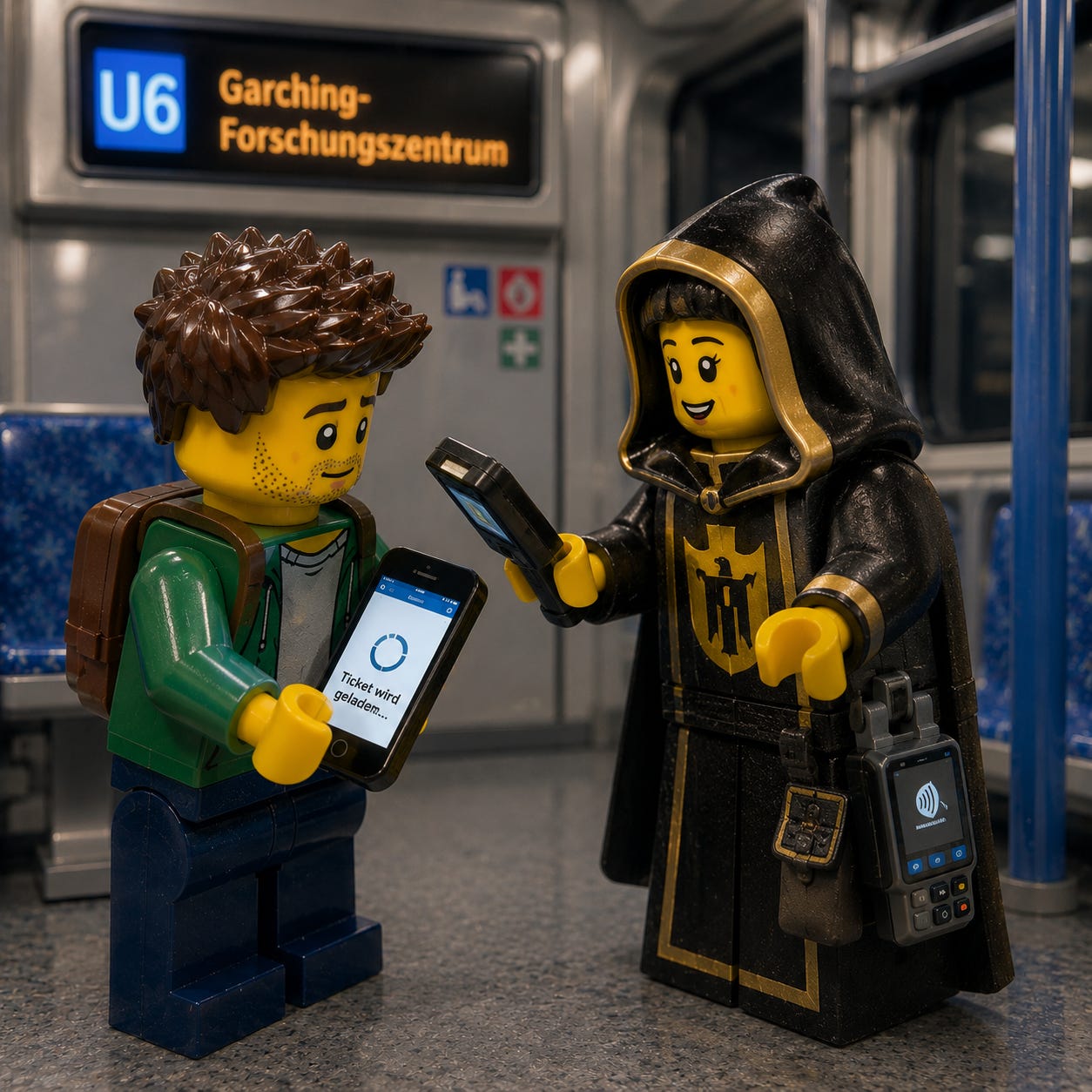
Unfortunately, my digital Deutschlandticket chose that exact moment not to load.
The app froze and appeared to be having a minor existential crisis.
Suddenly I was in a uniquely 21st Century situation; you know you’ve done the right thing, but technology is making you look guilty. And the longer it takes, the more you start to question your own compliance.
But the inspector was completely relaxed.
She looked at the loading screen, saw at me repeatedly refreshing it, and just shrugged in a very human way; as if to say: sometimes technology fails.
Eventually the ticket appeared, so all was fine.
[And no, she wasn’t dressed like that. I’ve rendered her as a modern version of the Münchner Kindl; the hooded figure from Munich’s coat of arms that still appears in important civic ceremonies.]
But it struck me afterwards that in lots of places I visit, that interaction would’ve felt very different.
The assumption would’ve been that I was up to no good; that an inability to instantly produce a ticket on demand, would’ve been a sign of guilt.
Which got me thinking about the way we treat non-compliance in other contexts.
It’s always easiest to assume the worst. Or perhaps the most commercially attractive. Because — whisper it — finding people who have failed to comply can sometimes be good for business.
Like parking attendants incentivised to err on the side of issuing tickets.
Sometimes the presumption of guilt is not only wrong, it risks undermining the system. After all, if there’s no room for human — or in this case, technological — failings, then the system becomes less likely to earn our respect.
And what I loved about my encounter this week is that there was a check. Those of us who had bought tickets felt reassured we had.
It just didn’t make honest people feel like criminals while it was being done.
Thanks for reading. If this made you curious about Humanizing Rules, you can download the first few chapters for free here.
Definitely experienced something like this before! Just had it today when my app wouldn't load to open the door at the coworking space— someone let me in, tailgating, and I felt guilty!
Reminds me of Jerry Michalski's idea of Design from Trust: eg
https://rethinkconstraints.substack.com/p/design-from-trust-how-to-build-better
"Design from Trust creates systems based on the assumption that participants are responsible and well-intentioned, rather than designing for the worst-case scenario. Most participants want to enjoy the system’s benefits; some would even like to help improve it. Instead of designing systems as if everyone is potentially a bad actor, limiting everyone’s behavior and discouraging them from engaging positively, DfT flips the script, and deals with the bad actors later, sometimes cleverly turning them into good actors.
More importantly, by designing in ways that give the good actors agency, responsibility, and leeway, DfT releases the genius that shows up whenever humans congregate. It takes a lot of trust to create a system that allows its participants to flow inside it to the places where they can make the most difference."